Insurance License in All 50 States: Non-Resident Fees by State
Short answer: pass the exam in one state only, your home state. Every other state, plus DC, gives you a nonresident license through NIPR without another exam, as long as your home-state license is active and covers the same lines. In 2026, state fees for all 50 states plus DC come to roughly $5,700 for property & casualty and $7,000 for all four major lines. That’s before carrier appointments.
Get an email before each license or CE deadline. Track every state free →
1. How to get an insurance license in all 50 states
Getting licensed nationwide does not require taking 50 different state exams. Under reciprocal licensing frameworks, you establish your resident foundation once and use centralized electronic systems to license across borders.
The six steps
- Get your resident license. Pre-licensing course, exam and background check in the state where you live. This is the only exam you take. Don’t apply anywhere else until the resident license shows as active in the NIPR Producer Database.
- Decide which lines you need everywhere. Nonresident states issue the lines of authority you hold at home and nothing more. Want life and health in Texas? You need life and health in your home state first.
- Apply for nonresident licenses on NIPR. Use the Non-Resident License (NRL) application at nipr.com. One application can cover several states, and every state charges its own fee on top of NIPR’s transaction fee.
- Handle the states that need extra steps. Most NRL applications go straight through. A “yes” on a background question means uploading documents to NIPR’s Attachments Warehouse. A few states ask for more, like Alabama’s proof of citizenship within 10 days. Fingerprints are rare for nonresidents, with two current exceptions: California asks for them if your home state didn’t fingerprint you, and Iowa starts doing the same for producer applicants on November 13, 2026.
- Get appointed. A license alone doesn’t let you sell for a carrier. Each carrier appoints you in each state, and the carrier usually pays the appointment fee.
- Put every renewal date in one place. At 51 licenses, a missed renewal turns into a reinstatement fee or a fresh application. Nonresident renewal dates don’t always match your home-state date.
2. Why you don’t need 50 exams: insurance license reciprocity
The NAIC Producer Licensing Model Act requires states to license a nonresident producer who is in good standing at home, unless the state has cause to deny. No second exam and no extra pre-licensing course. Continuing education works the same way. If you complete your home state’s CE, other states count you as compliant.
There are exceptions. States may require separate training for long-term care, flood or crop insurance. Annuity best-interest training is also tracked separately in many states. Check that before you sell those products in a new state.
Reciprocity applies line for line. If you hold only Property & Casualty at home, a nonresident state will not approve an application for Life or Accident & Health without an active resident credential on file.
3. Nonresident insurance license fees by state
A new nonresident producer license costs anywhere from $10 in Michigan to $380 in Illinois in state fees, and the median state charges $100. Getting licensed in all 50 states runs about $5,700 for property and casualty. Every fee in the table was checked against NIPR in November 2026.
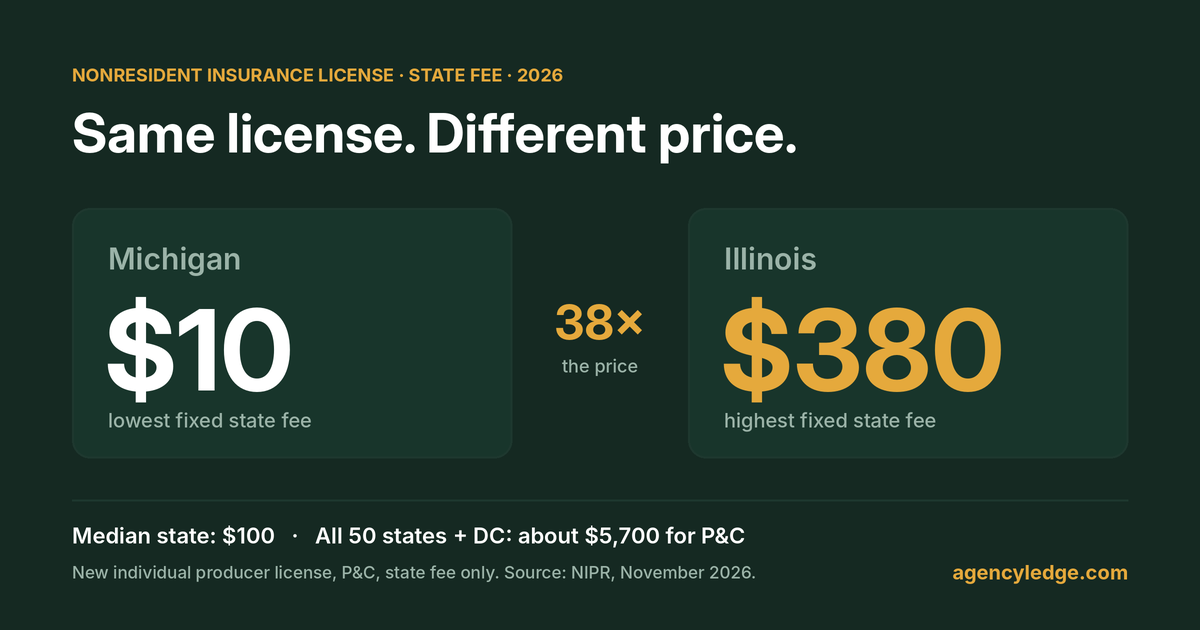
These are the state fees for a new individual nonresident producer license. They don’t include the $5.60 NIPR transaction fee. “P&C” means property and casualty (two lines). “All four” means life, health, property and casualty. Click a state name for the full licensing and renewal guide.
| State | P&C | All Four Lines | How the Fee Works |
|---|---|---|---|
| Alabama | $80 | $80 | per application (NIPR) |
| Alaska | $75 | $75 | per application (NIPR) |
| Arizona | $120 | $120 | per application (NIPR) |
| Arkansas | $70 | $70 | per application (NIPR) |
| California | $188 | $188 | per application (NIPR) |
| Colorado | $136 | $272 | $68 per line of authority (NIPR) |
| Connecticut | $140 | $140 | per application (NIPR) |
| Delaware | $125 | $125 | per application (NIPR) |
| District of Columbia | $100 | $200 | $100 per LOA grouping (life/health vs. P&C) (NIPR) |
| Florida | $60 | $70 | $50 + $5 per line of authority (NIPR) |
| Georgia | $120 | $220 | $100 per LOA combination + $20 processing fee (NIPR) |
| Hawaii | $225 | $225 | per application (NIPR) |
| Idaho | $80 | $80 | per application (NIPR) |
| Illinois | $380 | $380 | per application (prorated if under 2 years) (NIPR) |
| Indiana | $90 | $90 | per application; retaliatory fee may apply (NIPR) |
| Iowa | $50 | $50 | per application (NIPR) |
| Kansas | $40 | $40 | per application (NIPR) |
| Kentucky | $150 | $250 | $50 per line + $50 application fee (NIPR) |
| Louisiana | $75 | $75 | per application (NIPR) |
| Maine | $55 | $55 | per application (includes $15 app fee) (NIPR) |
| Maryland | $54 | $54 | per application (NIPR) |
| Massachusetts | $300 | $300 | $225 + $75 lead paint surcharge on P&C (NIPR) |
| Michigan | $10 | $10 | per application (NIPR) |
| Minnesota | $160 | $260 | $50 + $50/line + $10 technology fee (NIPR) |
| Mississippi | $100 | $100 | per application (+ $1 online fee) (NIPR) |
| Missouri | $100 | $100 | per application (NIPR) |
| Montana | $100 | $100 | per application (NIPR) |
| Nebraska | Home-state fee | Home-state fee | retaliatory: mirrors your resident state (NIPR) |
| Nevada | $185 | $185 | per application (NIPR) |
| New Hampshire | $210 | $210 | per application (NIPR) |
| New Jersey | $170 | $170 | per application (NIPR) |
| New Mexico | $30 | $30 | per application (NIPR) |
| New York | Home-state fee | Home-state fee | retaliatory: mirrors your resident state (NIPR) |
| North Carolina | $144 | $244 | $44 + $50 per line (NIPR) |
| North Dakota | $100 | $100 | per application (NIPR) |
| Ohio | $20 | $40 | $10 per line of authority (NIPR) |
| Oklahoma | $120 | $120 | $100 + $20 service of process fee (NIPR) |
| Oregon | $100 | $100 | per application (NIPR) |
| Pennsylvania | $110 | $110 | per application (NIPR) |
| Rhode Island | $130 | $130 | per application (NIPR) |
| South Carolina | $25 | $25 | per application (NIPR) |
| South Dakota | $30 | $30 | per application (NIPR) |
| Tennessee | Home-state fee | Home-state fee | retaliatory: mirrors your resident state (NIPR) |
| Texas | $50 | $50 | per license type (General Lines Agent) (NIPR) |
| Utah | $75 | $75 | per application (NIPR) |
| Vermont | Home-state fee | Home-state fee | retaliatory: mirrors your resident state (NIPR) |
| Virginia | $30 | $60 | $15 per line of authority (NIPR) |
| Washington | $55 | $55 | per application (NIPR) |
| West Virginia | $50 | $50 | per application (NIPR) |
| Wisconsin | $150 | $300 | $75 per line of authority (NIPR) |
| Wyoming | $150 | $300 | $150 per LOA group (life/health vs. P&C) (NIPR) |
Nebraska, New York, Tennessee and Vermont charge a retaliatory fee. You pay whatever your home state charges their residents for the same license. Indiana charges $90 unless a retaliatory fee applies to your home state. The schedules are on each state’s NIPR page.
4. What it costs to get licensed in all 50 states
The 47 jurisdictions with a fixed fee add up to $5,117 for P&C and $6,113 for all four lines. To calculate your exact nationwide total:
Formula for Your Nationwide Total
- Subtract your home state’s fee: You do not purchase a nonresident license where you reside.
- Add the four retaliatory states: Billed at your home state’s nonresident licensing rate.
- Add NIPR transaction fees: Roughly $280 ($5.60 per state filing).
For most producers, this totals approximately $5,700 for P&C and $7,000 for all four major lines (excluding home state pre-licensing and testing fees).
Where the money goes is lopsided. Illinois alone is $380. Massachusetts is $300 once you add the $75 lead paint surcharge on P&C lines. Michigan is $10. Ohio and Virginia charge per line, so a P&C-only license costs $20 and $30 there.
Then there’s the recurring bill. Each nonresident license has its own renewal fee and its own date, set by that state. Check the state’s NIPR renewal page and budget for it before you apply everywhere at once.
5. Do you need all 50, or just multiple states?
Usually not. Licenses everywhere make sense when you sell remotely to clients nationwide or service accounts with locations in many states. If you write a contractor with jobs in three states, you need those three, not 50.
Getting licensed in multiple states works exactly like getting all 50: same NIPR application, fewer states ticked. Start with the states where you already have clients or warm leads. Add states as business shows up. Adding a state later is the same NIPR application you’d file today, and every state you skip is one less fee and one less renewal to track.
6. If your agency sells in other states
The agency usually needs its own nonresident business entity license in each state, separate from your individual licenses. Most states require a designated responsible licensed producer (DRLP) on the entity application. That person must hold an active license in that state for the lines the agency applies for. The entity application also goes through NIPR.
7. If you move to another state
Your licenses don’t disappear. Update your address with each state within 30 days. Then apply for a resident license in your new state within 90 days of moving. Under the Model Act the new state can’t make you retake the exam for lines you already held. Your old resident license becomes a nonresident license.
8. Frequently asked questions
Yes. After your resident license is active, NIPR’s nonresident application lets you pick several states in one session. You still pay each state’s fee and NIPR’s transaction fee for each one.
No. You take one exam, in your home state. Nonresident states license you based on your home-state license.
About $5,700 for property and casualty, or about $7,000 for life, health, property and casualty, in state and NIPR fees. The exact number depends on your home state, which you subtract, and the retaliatory fees in Nebraska, New York, Tennessee and Vermont.
Generally no. Completing your home state’s CE counts for your nonresident licenses. Watch for product-specific training such as long-term care, flood or annuity best interest, which some states require separately.
Michigan, at $10. Ohio is $10 per line of authority, and South Carolina is $25.
Illinois, at $380 for a new nonresident producer license. Massachusetts comes to $300 with P&C lines.
Fees checked against NIPR state requirement pages on November 10, 2026. States change fees without much notice, so check the state’s NIPR page before you pay.